How to Draw Phase Plane Trajectory
Phase Portraits of Linear Systems
Consider a linear homogeneous organisation
  . We think of this every bit describing the motion of a bespeak in the
  aeroplane (which in this context is called the phase plane), with the independent variable
  as fourth dimension. The path travelled by the point in a solution is called a trajectory of the arrangement. A picture of the trajectories is called a phase portrait of the system. In the animated version of this page, you can see the moving points too as the trajectories. But on paper, the all-time we can exercise is to use arrows to indicate the direction of motion.
 In this section we study the qualitative features of the phase portraits, obtaining a classification of the different possibilities that can ascend. One reason that this is important is considering, equally we will see shortly, information technology will be very useful in the written report of nonlinear systems. The classification will non be quite consummate, because we'll leave out the cases where 0 is an eigenvalue of  .
.
The first step in the nomenclature is to find the characteristic polynomial, 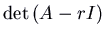 , which will exist a quadratic: nosotros write it as
  where
where  and
and  are real numbers (assuming every bit usual that our matrix has existent entries). The classification will depend mainly on and , and nosotros make a chart of the possibilities in the
  plane.
Now nosotros look at the discriminant of this quadratic,  . The sign of this determines what blazon of eigenvalues our matrix has:
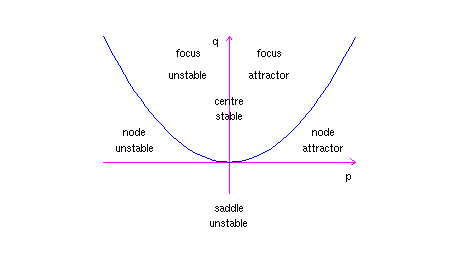
Each of these cases has subcases, depending on the signs (or in the complex case, the sign of the real role) of the eigenvalues. Notation that is the production of the eigenvalues (since  ), so for
  the sign of determines whether the eigenvalues take the aforementioned sign or opposite sign. We will ignore the possibility of
  , as that would mean 0 is an eigenvalue.
The sum of the eigenvalues is  , then if they take the same sign this is reverse to the sign of . If the eigenvalues are circuitous, their real role is
  .
.
Some other important tool for sketching the phase portrait is the post-obit: an eigenvector  for a real eigenvalue
  corresponds to a solution
  that is e'er on the ray from the origin in the management of the eigenvector . The solution
  is on the ray in the reverse management. If
  the motion is outward, while if
  it is inward. As
  (if ) or
  (if
(if  ), these trajectories approach the origin, while as
  (if ) or
  (if ) they go off to
  . For complex eigenvalues, on the other paw, the eigenvector is not then useful.
In improver to a classification on the basis of what the curves wait like, we will want to hash out the stability of the origin as an equilibrium point.
Hither, and so, is the nomenclature of the phase portraits of linear systems.
- If ,
 and
and  , we take two negative eigenvalues. There are straight-line trajectories corresponding to the eigenvectors. The other trajectories are curves, which come up in to the origin tangent to the ``slow'' eigenvector (respective to the eigenvalue that is closer to 0), and as they go off to arroyo the direction of the ``fast'' eigenvector.
 This example is called a node. Information technology is an attractor.
Here is the picture for the matrix
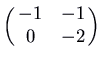 , which has feature polynomial
  . The eigenvalues are
  (deadening) and
  (fast), corresponding to eigenvectors
  and
and  respectively.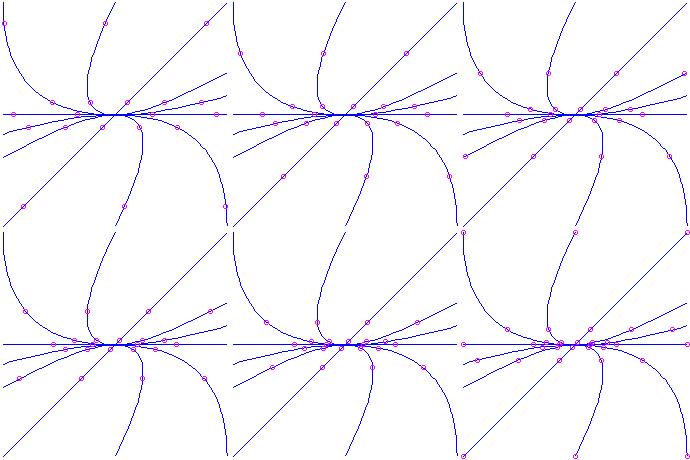
- If , and
 , we have ii positive eigenvalues. The picture is the aforementioned as in the previous case, except with the arrows reversed (going outward instead of inward). Again the curved trajectories come in to the origin tangent to the ``slow'' eigenvector (corresponding to the eigenvalue that is closer to 0), and as they become off to approach the management of the ``fast'' eigenvector. This is also a node, but information technology is unstable. Here is the picture for the matrix
  , which has characteristic polynomial
  . The eigenvalues are
  (wearisome) and
  (fast), corresponding to eigenvectors and respectively. Note that the picture is exactly the aforementioned every bit what we had for the attractor node, except that the direction of time is reversed (the animation is run backwards).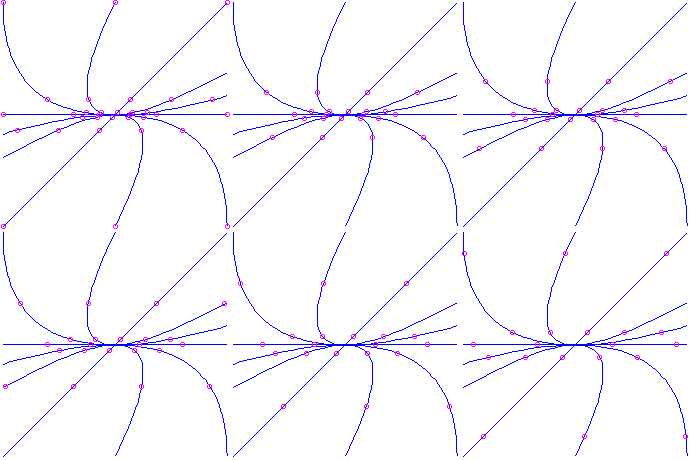
- If and
 , we have i positive and one negative eigenvalue. Again there are straight-line trajectories respective to the eigenvectors, with the motion outwards for the positive eigenvalue and inwards for the negative eigenvalue. These are the but trajectories that arroyo the origin (in the limit equally for the positive and for the negative eigenvalue). The other trajectories are curves that come in from asymptotic to a straight-line trajectory for the negative eigenvalue, and go dorsum out to asymptotic to a straight-line trajectory for the positive eigenvalue.
 This is called a saddle. It is unstable. Notation that if yous first on the straight line in the direction of the negative eigenvalue you do approach the equilibrium point as
 , but if you offset off this line (fifty-fifty very slightly) you end up going off to .
 Here is the picture for the matrix
 , which has characteristic polynomial
  . The eigenvalues are and , respective to eigenvectors and respectively.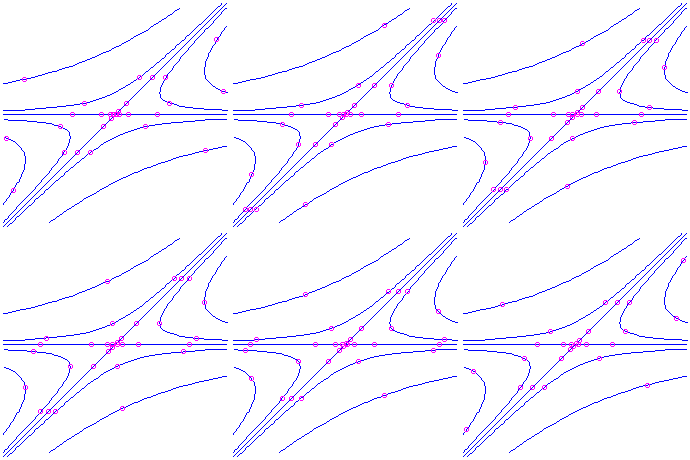
- If
 , we have simply one eigenvalue (a double eigenvalue). There are two cases here, depending on whether or non at that place are ii linearly independent eigenvectors for this eigenvalue.
 - If there are two linearly independent eigenvectors, every nonzero vector is an eigenvector. Therefore we take directly-line trajectories in all directions. The motion is e'er inward if the eigenvalue is negative (which means ), or outwards if the eigenvalue is positive (
 ). This is called a singular node. It is an attractor if and unstable if .
 Hither is the picture for the matrix
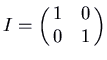 , which has feature polynomial
  and eigenvalue . Information technology is unstable. For the matrix
  nosotros would have an attractor: the same movie except with time reversed.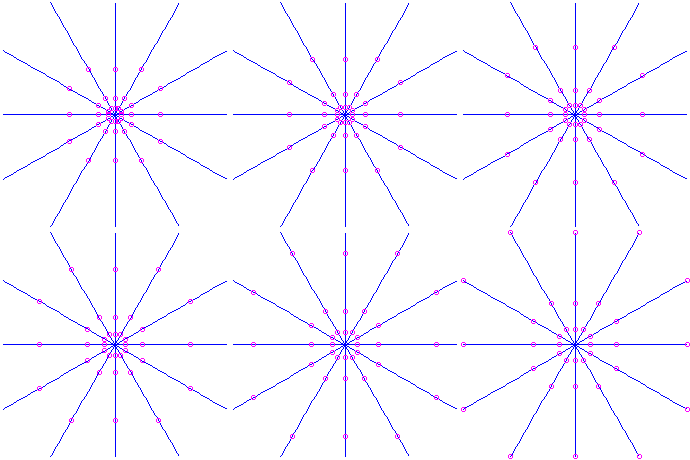
- If at that place is just one linearly independent eigenvector, there is only one straight line. The other trajectories are curves, which come in to the origin tangent to the directly line trajectory and curve around to the opposite direction. Trajectories on reverse sides of the direct line form an ``Southward'' shape. The mode to tell whether it is a forwards South or backwards S is to look at the direction of the velocity vector
 at some bespeak off the straight line.
 This is chosen a degenerate node. Again, it is an attractor if
and unstable if . Here is the picture for the matrix
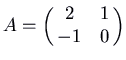 , which has feature polynomial , eigenvalue 1 and eigenvector
  . It is unstable. Notation that the trajectories in a higher place the straight line
  are come up out of the origin heading to the left along that line, and those below the line come up out heading to the right. Thus the South is forwards. To check this, you could calculate the velocity vector at, for example,
  , which is
 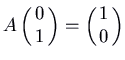 . Since that points to the right, it's easy to see the Southward must exist forwards.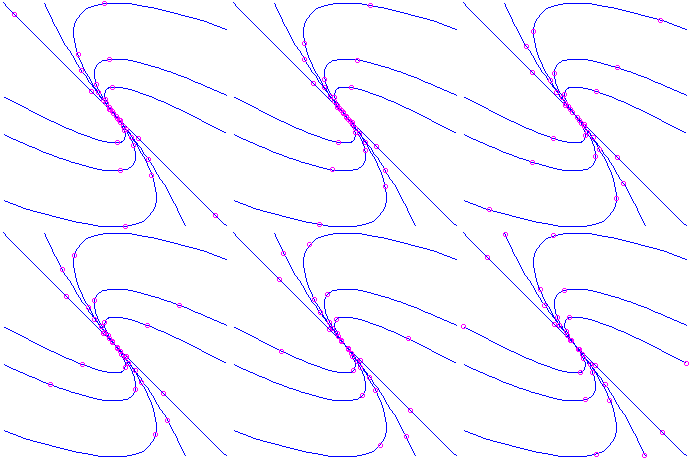
- If there are two linearly independent eigenvectors, every nonzero vector is an eigenvector. Therefore we take directly-line trajectories in all directions. The motion is e'er inward if the eigenvalue is negative (which means
- If
 and
and  , nosotros have complex eigenvalues
  . The solutions are of the class
  times some combinations of
  and
and  . The picture is a spiral, too known as a focus. It is an attractor if , as the factor makes all solutions arroyo the origin every bit , and unstable if , as in that case the factor makes all solutions (except the one starting at the equilibrium point itself) go off to as . We tin can summate a velocity vector to check if the motion is clockwise or counterclockwise.
 Here is the picture for the matrix
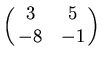 , which has characteristic polynomial
 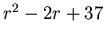 and eigenvalues
  . It is unstable. To check that the motion is clockwise, you could note that the velocity vector at is
  , which is to the right.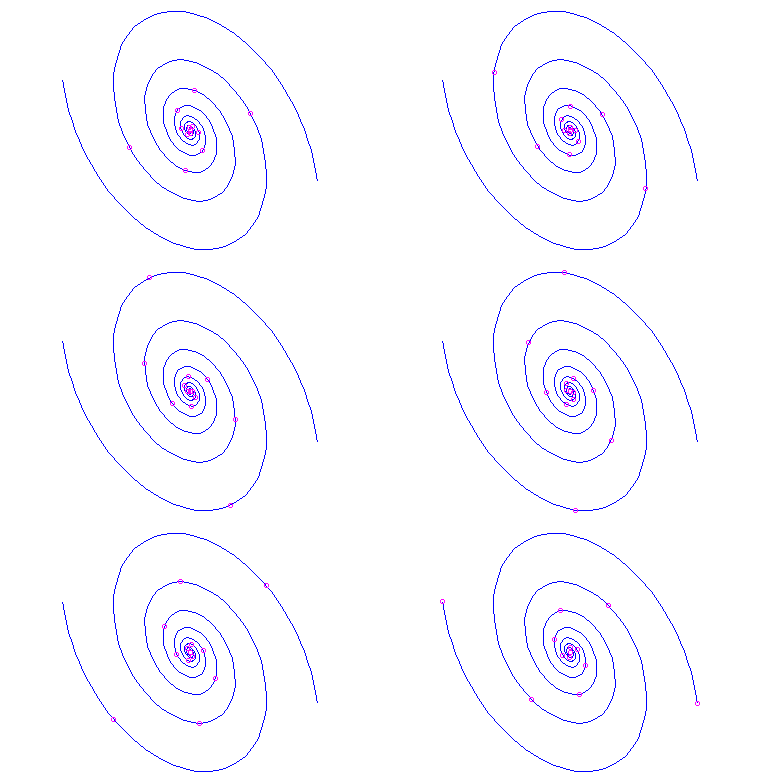
- Finally, if
 and
and  , nosotros have pure imaginary eigenvalues
  . The solutions involve combinations of
  and
and  . These are all periodic, with menstruation
  . The trajectories plow out to exist ellipses centred at the origin. The picture is known equally a centre. Since a solution that starts about the origin simply goes around and around the same ellipse, never getting any closer to or farther from the equilibrium than the closest and farthest points on the ellipse, this equilibrium is stable but not an attractor. Again we can summate a velocity vector to run into whether the motion is clockwise or counterclockwise.
 Here is the moving picture for the matrix
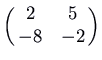 , which has feature polynomial
  and eigenvalues
  . Once again you tin check that the motion is clockwise by noting that the velocity vector at is
  , which is to the right.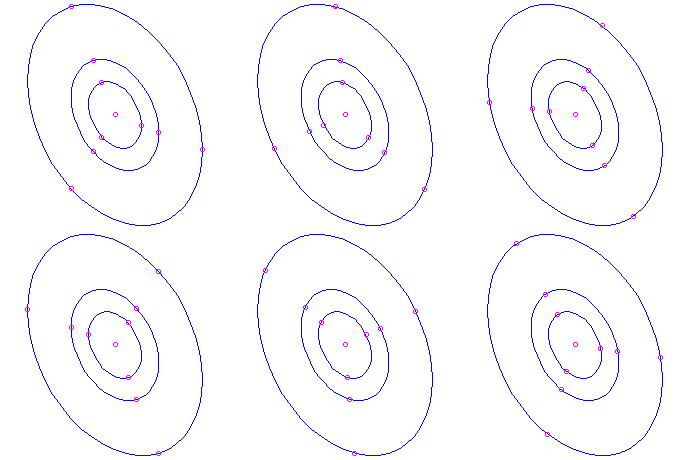
- About this certificate ...
Robert Israel
2002-03-24
colliermagesentrage1994.blogspot.com
Source: https://www.math.ubc.ca/~israel/m215/linphase/linphase.html
0 Response to "How to Draw Phase Plane Trajectory"
Postar um comentário