whats the best way to connect stair railing parts
Install a New Stair Handrail
Then strong it's kid-proof! We'll testify you how to practise it.
 Time
Time
A full day
 Complexity
Intermediate
 Cost
Cost
$51–100
Introduction
If you have a loose stair runway, a weak stair rail or no runway at all, prepare the problem by installing a solidly anchored railing like we bear witness here. Would your stair rail hold up to iii energetic youngsters hanging on it like this? If you lot're not sure, or if you have stairways with missing rails, at present's the time to prepare the trouble. More accidents happen on stairways than anywhere else in the business firm, and a strong stair rail goes a long way toward making stairs safer and easier to utilize. In this article, we'll show you how to cut and gather your rails, how to mount information technology solidly to the wall framing and determine the proper handrail meridian.
Tools Required
Materials Required
- 150-grit sandpaper
- 4d finish nails
- 90-second epoxy
- Masking tape (1-i/2-in. wide)
- Railing brackets
- Railing material
- Forest mucilage
Measure the stair and purchase the stair railing
The blueprint we chose to replace stair railings lightly exceeds the edifice codes in many regions. We extended the stair railing beyond both the top and the lesser steps. While this isn't always possible, it allows yous to grasp the stair railing sooner and hold onto the stair handrail longer to maintain good balance.
Before you go shopping for your handrails for stairs, measure from the nosing of the summit landing to the floor at the bottom of the stairs and add together 2 ft. This is the length of stair railing material you'll demand. You'll observe code-approved handrail and the other materials you'll demand at lumberyards and abode centers.
Hardwood handrails for stairs similar the oak stair railing we're using are more expensive. Pine and poplar track cost less. In add-on to the stair railing, you'll need wall mounted handrail brackets, a package of ii-office, 90-2nd epoxy, and about four ft. of two×4. Buy enough brackets to install two at the peak, one at the bottom and one every 48 in. between the top and the bottom of the stair railing.
Check out these 100 home improvement hacks yous'll wish you knew sooner.
Project footstep-by-step (17)
Pace 1
Mark the studs and standard railing height
To replace stair railing, start by finding and marking studs. In order to be safe, handrails for stairs must be anchored securely to the wood framing behind the drywall or plaster.
Here are a few tips for locating the studs:
- Start by inspecting the brim board to run into if you can detect a design of nails that may indicate studs. Then use a stud finder to verify the locations.
- Almost studs are xvi in. on center, so one time y'all find one, you lot can try measuring horizontally to locate the adjacent one.
- When you find a stud, mark information technology with a strip of masking tape. Nosotros used blue tape for photo clarity, just piece of cake-to-remove (low tack) masking record would be a better option to avert damaging the paint or wallpaper.
- Mark every stud along the stairs plus one beyond the summit and lesser risers. You'll decide afterward which ones to use. Studs aren't e'er where you lot want them.
- If no stud is available at the top, utilise metallic toggle anchors to mount the subclass nether the short horizontal section of track.
- If the wall ends shut to the top or bottom footstep, you won't be able to extend the rail. Instead, simply return it to the wall.
In improver to finding the studs, you lot have to make marks at the top and bottom of the stairway to point the standard railing height of the rail above the stairs. To meet edifice lawmaking requirements, the stair railing should be mounted so that the top of the handrail height is 34 to 38 in. above the front border of the stair nosings. We chose 36 in. Step 3 (below) shows how to find this wall mounted handrail= meridian point at the superlative of the stair. Don't be one of those guys! Check out these13 cringe-worthy habitation improvement fails.
Stride 2
Locate the studs
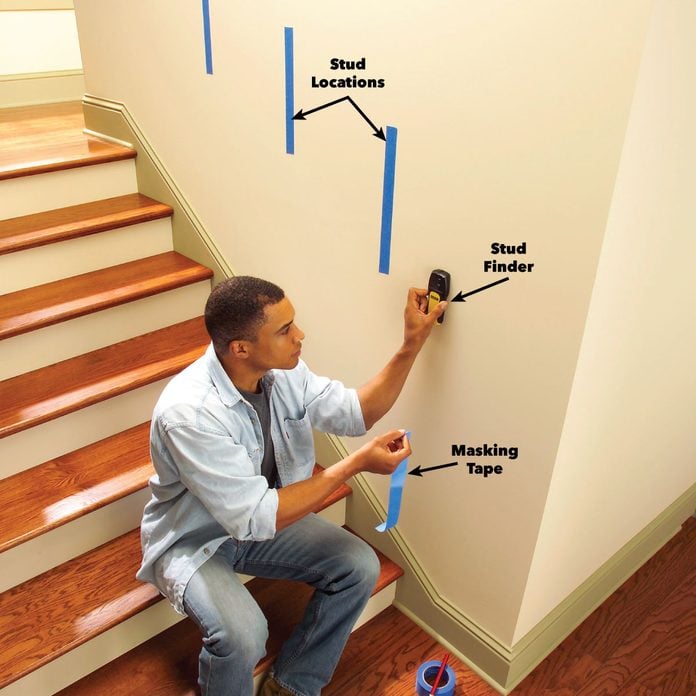
Locate the studs in the wall in a higher place the stairs. Use a stud finder and marker the locations with strips of 1-1/2 in. masking tape centered about 36 in. to a higher place the stairs.

Step 3
Plumb up from the front edge
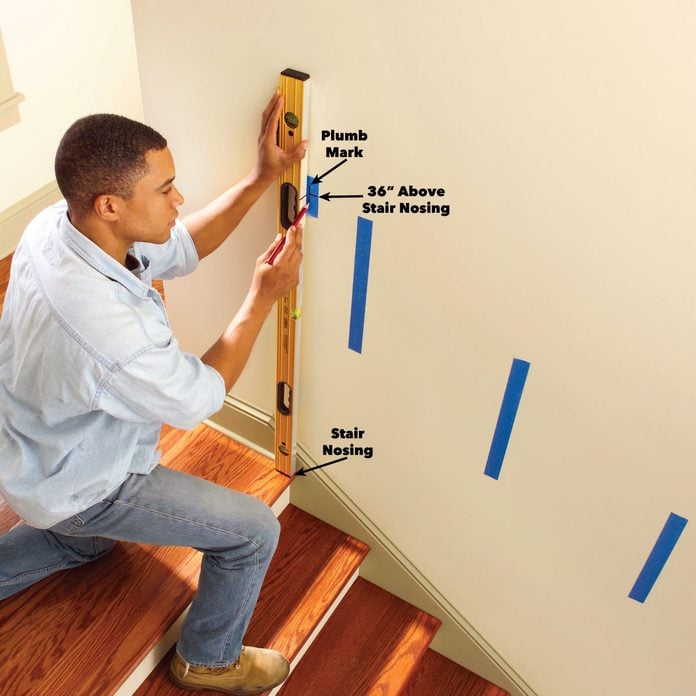
Plumb up from the front edge of the pinnacle stair nosing and stick a piece of tape to the wall. Make a vertical line even with the front of the nosing and a horizontal line at 36 in. Do the same at the bottom tread.
Later you'll align the acme of the rail with these handrail peak marks and locate the rail brackets. And so yous'll use the mark at the meridian to position the track earlier you attach information technology to the brackets.
Step four
Cutting the rails to length and fit the joint
The next step is to cutting the stair railing and mucilage on the brusque horizontal section at the top. Since the rail runs parallel to the stairs, you can use the stair noses as a guide for cutting the rail to the right length and figuring the peak angle.
Stride 5
Cut a 45-caste miter

First by cutting a 45-degree bending on one end of the stair railing and rest this end on the flooring. This cut is for the short return to the wall.
Step 6
Close-Up: Cutting a 45-degree miter
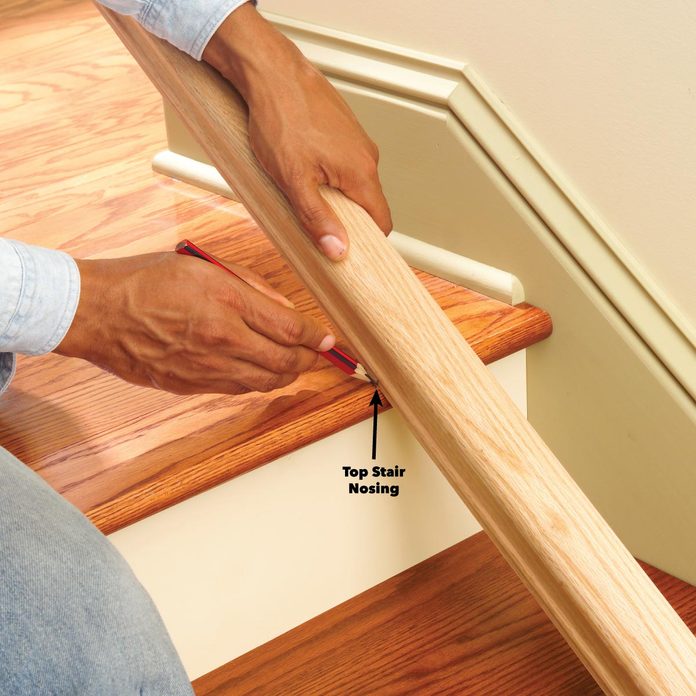
With the rails resting on the forepart of the stair treads, marking where the rails contacts the peak stair nosing.
Footstep 7
Power miter saw

Gear up your ability miter saw to cut a 16-degree angle and saw the rail at the mark. Cut the opposite 16-degree bending on the remaining track piece. Apply information technology for the horizontal tiptop department. This is an gauge bending. Y'all'll examination the fit.
Step 8
Examination the fit

Test the fit of the track joint. Adjust the cut bending and recut both pieces until the joint is tight. Don't worry if you lose a little length on the rail. It'll just reduce the distance the rail extends at the bottom, which isn't critical.
When you're satisfied with the fit, cut the brusk horizontal stair railing section to length with a 45-degree miter on the cease. Get in long enough to extend a few inches past the adjacent stud and so y'all can add a wall-mounted handrail subclass under it.
Step nine
Gum the joint with epoxy
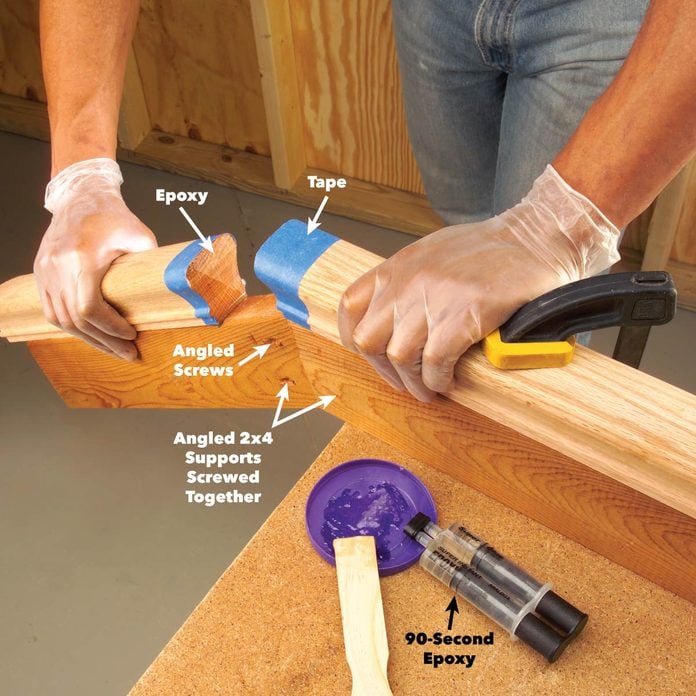
The shallow angle makes it difficult to bring together the short and long stair railing sections with nails or screws. And dowels or other joining methods require a furniture maker'southward precision. Then instead we'll show you a simple method to bring together the ii with fast-setting epoxy.
Cut 2x4s on edge at the aforementioned angle equally the rail and join them with screws driven at an bending. And then back up the rail sections with the 2x4s as you press and hold the joint together. With xc-2nd epoxy, you'll be able to paw-agree the joint together long enough for the epoxy to take hold of. Concentrate on keeping the profiles exactly lined upwardly and pressing the runway tight together to eliminate gaps. So exit the joint undisturbed for at least an 60 minutes. Overnight would be better, since the epoxy doesn't approach maximum forcefulness for at least 24 hours.
To protect the wood from epoxy that may ooze out, wrap the rails ends with masking tape. Trim backlog tape flush to the cut finish with a sharp utility knife. Then carefully remove the record after the epoxy has fix for five minutes. The finished articulation will probably require sanding to even up the edges. Practise this after the epoxy hardens.
Step 10
Align the peak of the stair guardrail

Align the elevation of the handrail with the 36-in.-high marks on the tape (see close-upwardly photograph, beneath), and mark along the underside of the rails at each stud location for the handrail superlative.
Step 11
Close-Upwardly: Align the top of the stair guardrail
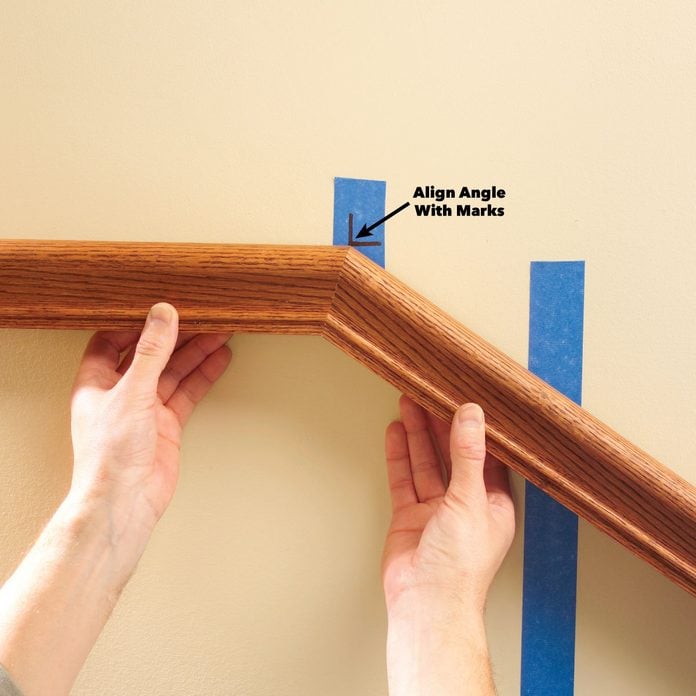
Align the railing with the joint marker on the wall and pay close attention to the handrail acme.
Step 12
Eye the rail bracket

Centre the stair railing bracket vertically on the stud and sight across the tiptop to align it with the mark to ensure the handrail height. Then mark all three screw holes. Do this at the studs closest to the top and bottom of the rail.
Step thirteen
Locate the center of the stud
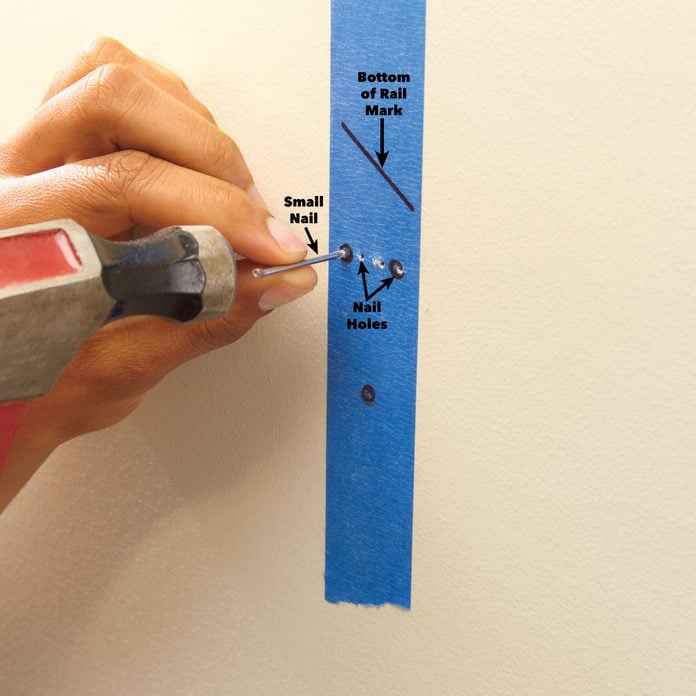
Locate the exact centre of the studs. Probe the wall with a finish nail to locate the exact eye of the stud. Tap gently to feel when the nail hits solid forest or misses the stud and goes in easily. Shift the bracket if necessary to center it on the stud until there's solid forest behind both top holes and the proper handrail height is maintained.
This is an important step because the rail brackets must be centered on the stud or one of the two top screws will miss the framing. If you shift the bracket, make sure to adjust the handrail summit to keep the tiptop aligned with the mark. You may have to patch a few nail holes, but this beats having a bracket pull loose.
Stride 14
Drill airplane pilot holes

Drill 1/viii-in. airplane pilot holes for the rail subclass screws. You should feel the bit drilling into solid wood. Angle holes slightly toward the eye to make sure the spiral catch the stud and to have proper handrail acme.
Footstep 15
Spiral the subclass to the wall

Remove the masking record and screw the bracket to the wall. Angle the height screws slightly to follow the angled pilot holes
Be conscientious when you drive the screws included with the brackets. The heads will pause off hands if y'all don't predrill pilot holes. If y'all're driving the screws with a drill, mount the bit in a magnetic bit holder to extend it away from the drill. This volition requite you more clearance for driving the angled screws.
Step 16
Attach the rail to the brackets

Install the top and bottom brackets get-go and mount the rail to them. Attach the rails to the brackets with the screws and strap provided. And then add the bracket under the short horizontal section. Finally, sight down the stair railing and straighten it before calculation the intermediate brackets.
Step 17
Add the returns and finish up
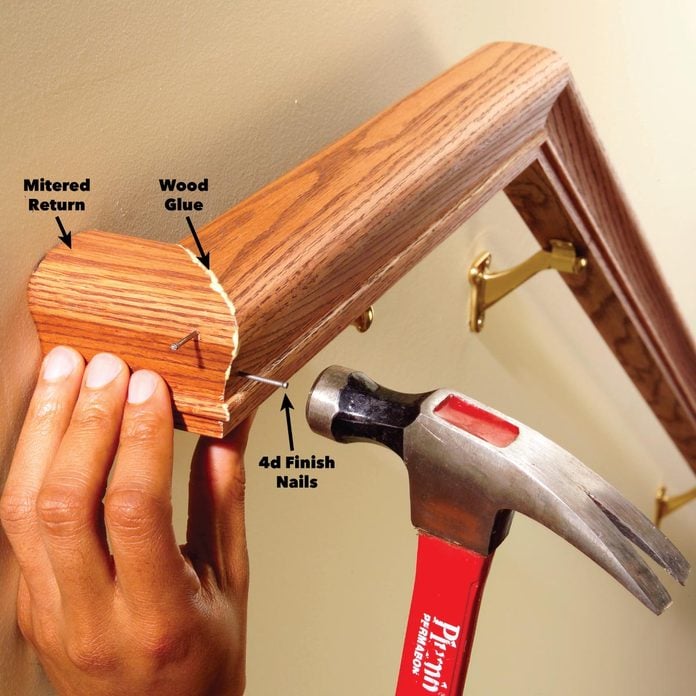
With the stair railing mounted, it'due south piece of cake to measure for and install the short pieces that return to the wall at the meridian and bottom of the rail.
Measure from the long point of the 45-degree miter on the rail to the wall and add well-nigh 1/xvi in. for a tight fit. Then cutting the returns on your power miter saw. Cut them from longer pieces (at to the lowest degree 12 in.) to avoid getting your fingers also shut to the bract.
These returns are required past the building code, and for good reason. They eliminate the possibility that loose article of clothing or a purse strap could get hung upwardly and cause a fall. Also, they create a dainty finished look on the ends of the stair railing. We fastened the returns with forest glue and 4d end nails, simply you could likewise use the remaining 90-second epoxy. Predrill 1/16-in. holes, and so glue and tack the joint with 4d finish nails. Recess the nails with a boom set.
Once the rail is consummate, you can take it off to paint or finish it by simply removing the screws from the U-shaped brackets. Since the spiral holes are already drilled, it'll be easy to reinstall.
Hither'southward how to install an outdoor stair railing.
Originally Published: August 09, 2019
colliermagesentrage1994.blogspot.com
Source: https://www.familyhandyman.com/project/install-a-new-stair-handrail/
0 Response to "whats the best way to connect stair railing parts"
Postar um comentário