| 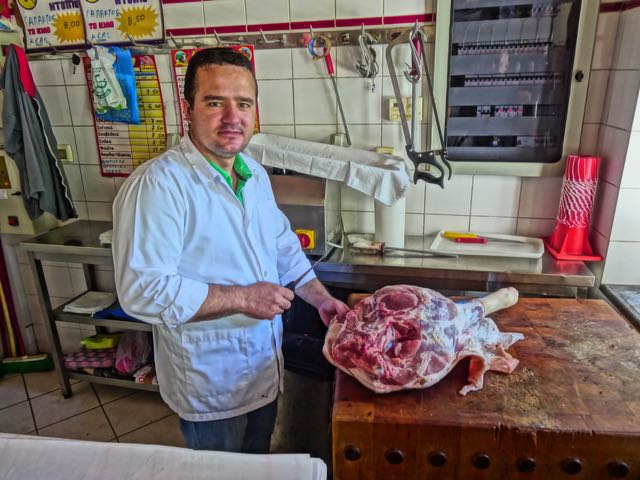 In the final few years Doctors, nutritionists and dietitians have been singing the praises of the Mediterranean diet, claiming it is the respond to all sorts of ailments from obesity to high cholesterol and fifty-fifty cancer. But anyone visiting Greece would wonder exactly what is meant by the Mediterranean diet, for while those of us outside the Mediterranean have been eating more whole grains, extra virgin olive oil and fresh vegetables, the Greeks have been eating more meat, turning a one time or twice a week special occasion food to a daily affair, sometimes twice daily. As the Greeks became more affluent they ate more than meat. There is still some testify that the skilful stuff they eat more than makes up for the drawbacks of a meat-heavy diet in the same way that people wonder how the French can swallow such rich nutrient and not be obese. In the final few years Doctors, nutritionists and dietitians have been singing the praises of the Mediterranean diet, claiming it is the respond to all sorts of ailments from obesity to high cholesterol and fifty-fifty cancer. But anyone visiting Greece would wonder exactly what is meant by the Mediterranean diet, for while those of us outside the Mediterranean have been eating more whole grains, extra virgin olive oil and fresh vegetables, the Greeks have been eating more meat, turning a one time or twice a week special occasion food to a daily affair, sometimes twice daily. As the Greeks became more affluent they ate more than meat. There is still some testify that the skilful stuff they eat more than makes up for the drawbacks of a meat-heavy diet in the same way that people wonder how the French can swallow such rich nutrient and not be obese. | | 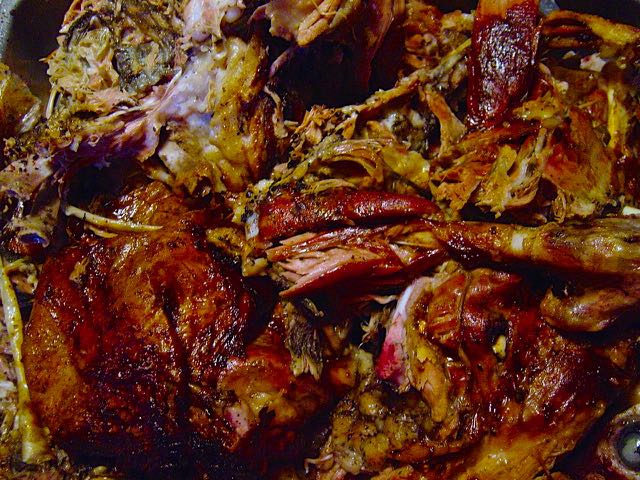 Nevertheless, if one lives on a Greek island, there is no better evidence of what the alter in the Greek diet has meant than to sentinel Athenians get off the ferry on a holiday weekend. In the villages the Greeks are active and are eating well. The Athenians on the other hand, are looking more like overweight Americans, non surprising since they are eating like Americans: candy nutrient, refined sugar and lots of meat. I am not complaining. After all in that location are those who claim that a protein rich, low-carb diet is the road to health. It may be one of many paths of which the near important is non to overindulge. Merely if you are visiting Greece for a couple weeks, why not indulge? Anyone who goes to Greece to lose weight is putting themselves in the same state of affairs equally the person who goes to Octoberfest to quit drinking beer. Nevertheless, if one lives on a Greek island, there is no better evidence of what the alter in the Greek diet has meant than to sentinel Athenians get off the ferry on a holiday weekend. In the villages the Greeks are active and are eating well. The Athenians on the other hand, are looking more like overweight Americans, non surprising since they are eating like Americans: candy nutrient, refined sugar and lots of meat. I am not complaining. After all in that location are those who claim that a protein rich, low-carb diet is the road to health. It may be one of many paths of which the near important is non to overindulge. Merely if you are visiting Greece for a couple weeks, why not indulge? Anyone who goes to Greece to lose weight is putting themselves in the same state of affairs equally the person who goes to Octoberfest to quit drinking beer. | Greek Meat Dishes | | 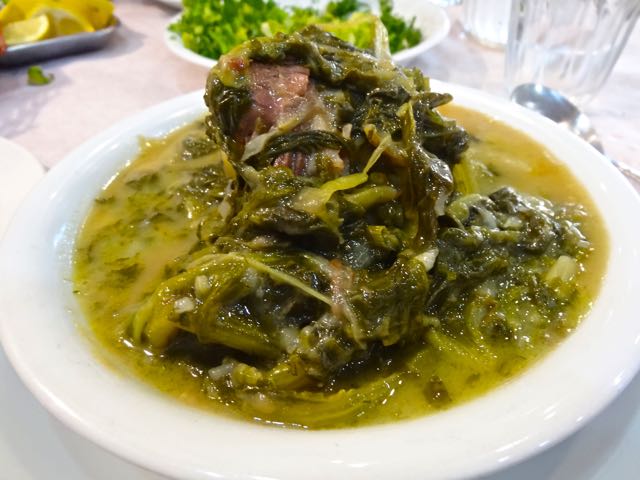 The near common meats in Greece are pork, lamb, beefiness, goat, chicken, veal and rabbit not necessarily in that order. Considering it was expensive in the past, earlier the Greeks became affluent plenty to eat it every day, meat was eaten possibly twice a week and ordinarily with vegetables, pasta or grains. One of the virtually well known meat dishes is mousaka, which is eggplant, ground beef (or lamb or pork), potatos and tomato sauce with b�chamel which illustrates the way the Greek chefs use meat as a component to a dish. Many meat dishes are cooked in tomatoes and red wine and others in lemon such as lamb fricasse, which is lamb cooked with endives or romaine lettuce and an egg-lemon sauce. Garlic is used heavily every bit are onions and potatoes in the many stews and oven baked dishes. There is a pork dish similar to fricasse which is fabricated with celery and served in the winter called hirino me celino. Dolmades (stuffed grape leaves), kolokithia gemista, (blimp zuchinni), tomates ke peperies gemista (stuffed tomatoes and peppers) and laxano gemista (stuffed cabbage) are other examples of stretching the meat by using information technology with rice and vegetables. Pastitsio is like lasagna though not as saucy and is fabricated with pasta, basis beef, tomatoes, onions and garlic and b�chamel sauce. Giovetsi is lamb broiled with orzo pasta and tomato plant sauce. The near common meats in Greece are pork, lamb, beefiness, goat, chicken, veal and rabbit not necessarily in that order. Considering it was expensive in the past, earlier the Greeks became affluent plenty to eat it every day, meat was eaten possibly twice a week and ordinarily with vegetables, pasta or grains. One of the virtually well known meat dishes is mousaka, which is eggplant, ground beef (or lamb or pork), potatos and tomato sauce with b�chamel which illustrates the way the Greek chefs use meat as a component to a dish. Many meat dishes are cooked in tomatoes and red wine and others in lemon such as lamb fricasse, which is lamb cooked with endives or romaine lettuce and an egg-lemon sauce. Garlic is used heavily every bit are onions and potatoes in the many stews and oven baked dishes. There is a pork dish similar to fricasse which is fabricated with celery and served in the winter called hirino me celino. Dolmades (stuffed grape leaves), kolokithia gemista, (blimp zuchinni), tomates ke peperies gemista (stuffed tomatoes and peppers) and laxano gemista (stuffed cabbage) are other examples of stretching the meat by using information technology with rice and vegetables. Pastitsio is like lasagna though not as saucy and is fabricated with pasta, basis beef, tomatoes, onions and garlic and b�chamel sauce. Giovetsi is lamb broiled with orzo pasta and tomato plant sauce. | | 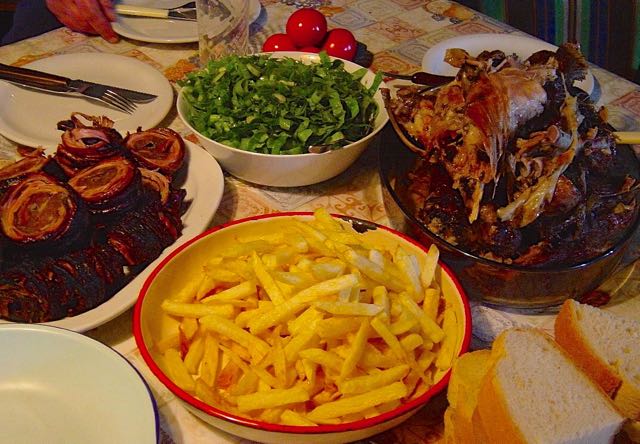 For Easter the near popular food for most of Greece is whole lamb roasted on a spit. This is especially popular because information technology follows xl days of fasting for lent and people are definitely gear up for some meat, though not everyone fasts the entire xl days. If y'all have ever been to an Easter dinner in Greece y'all undoubtedly accept memories of the men standing around watching the lamb turning over the hot coals, usually kept company past a kokoretsi, the intestines of the lamb stuffed with organ meat and as well spit-roasted. Usually this takes place outdoors on Easter Sunday but in some places they head directly from the midnight mass at the church to the local taverna for their arni and kokoretsi like we do when we spend Easter on Kea. For Easter the near popular food for most of Greece is whole lamb roasted on a spit. This is especially popular because information technology follows xl days of fasting for lent and people are definitely gear up for some meat, though not everyone fasts the entire xl days. If y'all have ever been to an Easter dinner in Greece y'all undoubtedly accept memories of the men standing around watching the lamb turning over the hot coals, usually kept company past a kokoretsi, the intestines of the lamb stuffed with organ meat and as well spit-roasted. Usually this takes place outdoors on Easter Sunday but in some places they head directly from the midnight mass at the church to the local taverna for their arni and kokoretsi like we do when we spend Easter on Kea. | | 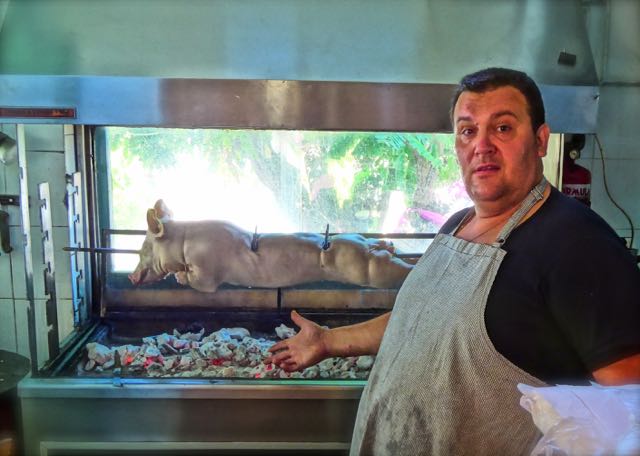 You don't have to expect for Easter to have roast lamb. Whole lamb and kokoretsi is sold in the psistarias (grill houses) all over Athens and especially on the roads outside of boondocks. Areas like Vari and Kalivia are known for the large grill houses that are full of carnivores on weekend nights and Sun afternoons. Likewise popular at these places are ourounopoulo, which is roast suckling pig, which I prefer to lamb, especially the crispy outer skin that even if information technology takes a year or so off your life is worth it. In some villages certain restaurants are known for the melt'due south ability to make the perfect squealer and Saturday nights you take to get at that place early on for a table. Kontosouvli is pork, big hunks of it skewered and put on a rotisserie with onions, tomatoes, peppers, and seasoned with common salt and pepper, garlic and oregano. Kotopoulo (chicken) can also be roasted on a rotisserie, grilled or oven-roasted with potatoes, garlic, onions and lemon. I bought a Outset Rotisserie for my house so that I tin can brand chicken and kontosouvli and Greek friends who have come to dinner have exclaimed that my firm smells like a psisatria. You don't have to expect for Easter to have roast lamb. Whole lamb and kokoretsi is sold in the psistarias (grill houses) all over Athens and especially on the roads outside of boondocks. Areas like Vari and Kalivia are known for the large grill houses that are full of carnivores on weekend nights and Sun afternoons. Likewise popular at these places are ourounopoulo, which is roast suckling pig, which I prefer to lamb, especially the crispy outer skin that even if information technology takes a year or so off your life is worth it. In some villages certain restaurants are known for the melt'due south ability to make the perfect squealer and Saturday nights you take to get at that place early on for a table. Kontosouvli is pork, big hunks of it skewered and put on a rotisserie with onions, tomatoes, peppers, and seasoned with common salt and pepper, garlic and oregano. Kotopoulo (chicken) can also be roasted on a rotisserie, grilled or oven-roasted with potatoes, garlic, onions and lemon. I bought a Outset Rotisserie for my house so that I tin can brand chicken and kontosouvli and Greek friends who have come to dinner have exclaimed that my firm smells like a psisatria.
| | 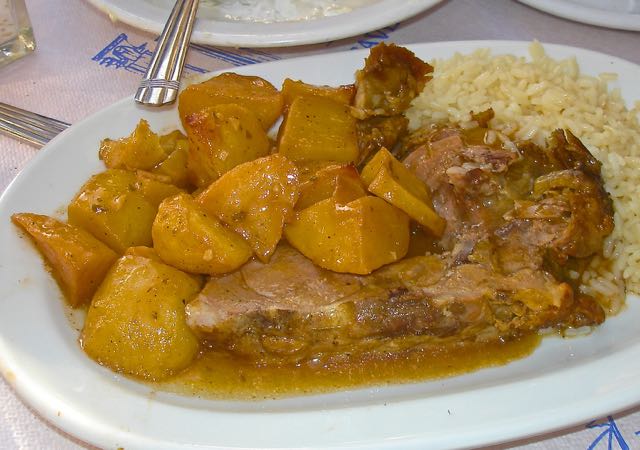 Lamb is also made in the oven with roast potatoes. Even today in many villages, the Sun dinner is brought to the bakery and for a small fee they melt the meal. This was because many homes did not have an oven, but even now that everyone has one they still bring their roast lamb and potatoes to the fourno (bakery) so that they don't have to brand the whole apartment unbearably hot, especially in the summertime. The recipe is pretty simple and consists of lamb, garlic, potatoes, table salt, pepper, oregano and lemon. This dish is found in simply about every restaurant that specializes in oven-cooked foods. You tin get the same dish but made with chicken too. They are called Arni (lamb) psito me potates sto fourno or kotopoulo (craven) psito me patates sto fourno. Katsiki (caprine animal) is similar to lamb, though not equally fatty, so therefore not equally tasty though many people prefer information technology. It can be rotisserie roasted but is found more oft in lemon sauce called katsiki lemonato with potatoes or with pasta, or Sifnos style, cooked in a dirt pot, called mastello (or in other places it is chosen stamna.) The meat and vegetables are put in a clay pot and sealed. They are then cooked in the oven for several hours. Beef and lamb and chicken tin can as well be plant cooked in lemon sauce, called lemonato. In that location is a dish chosen arni kleftiko which is similar to the roast lamb with potatoes only it is cooked in oiled parchment paper which makes it much more tender, almost as if it has been steamed first. It is called kleftiko because it was eaten by the Klefts, the guerrilla fighters who fought against the Turks in the war for Independence. The reason they cooked it this way is and then the paper would hide the aroma of the meat so their hideout would not exist given away. Lamb is also made in the oven with roast potatoes. Even today in many villages, the Sun dinner is brought to the bakery and for a small fee they melt the meal. This was because many homes did not have an oven, but even now that everyone has one they still bring their roast lamb and potatoes to the fourno (bakery) so that they don't have to brand the whole apartment unbearably hot, especially in the summertime. The recipe is pretty simple and consists of lamb, garlic, potatoes, table salt, pepper, oregano and lemon. This dish is found in simply about every restaurant that specializes in oven-cooked foods. You tin get the same dish but made with chicken too. They are called Arni (lamb) psito me potates sto fourno or kotopoulo (craven) psito me patates sto fourno. Katsiki (caprine animal) is similar to lamb, though not equally fatty, so therefore not equally tasty though many people prefer information technology. It can be rotisserie roasted but is found more oft in lemon sauce called katsiki lemonato with potatoes or with pasta, or Sifnos style, cooked in a dirt pot, called mastello (or in other places it is chosen stamna.) The meat and vegetables are put in a clay pot and sealed. They are then cooked in the oven for several hours. Beef and lamb and chicken tin can as well be plant cooked in lemon sauce, called lemonato. In that location is a dish chosen arni kleftiko which is similar to the roast lamb with potatoes only it is cooked in oiled parchment paper which makes it much more tender, almost as if it has been steamed first. It is called kleftiko because it was eaten by the Klefts, the guerrilla fighters who fought against the Turks in the war for Independence. The reason they cooked it this way is and then the paper would hide the aroma of the meat so their hideout would not exist given away. | | 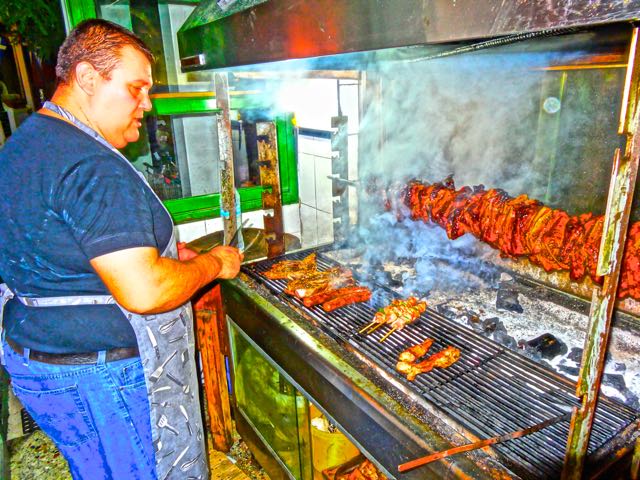 I of my favorite dishes is paidakia which are grilled lamb-chops and are to Greeks equally baby-back ribs are to a southerner. A political party of iv can easily eat a kilo of these and many restaurants are known for their paidakia. Ofttimes the rallying cry for a night out is "Allow's get for paidakia" and the evening begins at x pm and ends hours later after kilos of wine and lamb-chops every bit the waiters are sweeping up and the other parties around us are finishing their paidakia and leaving to go to the bouzoukia to mind to Greek music until the sun rises. Paidakia are meant to be eaten with your fingers and like baby-back ribs, require lots of napkins. Most people who endeavor them in Hellenic republic long for them when they leave. You lot tin't find good paidakia exterior of Hellenic republic or if you tin, I haven't. But even better than paidaikia is something called provatina which is actually the same thing except instead of using immature lambs they apply old ones. The gustation is stronger and the meat a little tougher just if you lot have a chef who knows what he is doing you will ever ask for provatina when yous go to a psistaria. I am lucky because in our village of Ioulida in Kea, Yannis at Kalofagadon, makes splendid provatina and in my sister-in-law'south village of Vatousa in Lesvos, Tryfon at Rena'south restaurant does as well. But I take friends who volition drive 2 hours to the mountains of Evia for proficient provatina. For those meat eaters who won't go beyond chicken there is good news. Many restaurants now have craven paidaikia. I of my favorite dishes is paidakia which are grilled lamb-chops and are to Greeks equally baby-back ribs are to a southerner. A political party of iv can easily eat a kilo of these and many restaurants are known for their paidakia. Ofttimes the rallying cry for a night out is "Allow's get for paidakia" and the evening begins at x pm and ends hours later after kilos of wine and lamb-chops every bit the waiters are sweeping up and the other parties around us are finishing their paidakia and leaving to go to the bouzoukia to mind to Greek music until the sun rises. Paidakia are meant to be eaten with your fingers and like baby-back ribs, require lots of napkins. Most people who endeavor them in Hellenic republic long for them when they leave. You lot tin't find good paidakia exterior of Hellenic republic or if you tin, I haven't. But even better than paidaikia is something called provatina which is actually the same thing except instead of using immature lambs they apply old ones. The gustation is stronger and the meat a little tougher just if you lot have a chef who knows what he is doing you will ever ask for provatina when yous go to a psistaria. I am lucky because in our village of Ioulida in Kea, Yannis at Kalofagadon, makes splendid provatina and in my sister-in-law'south village of Vatousa in Lesvos, Tryfon at Rena'south restaurant does as well. But I take friends who volition drive 2 hours to the mountains of Evia for proficient provatina. For those meat eaters who won't go beyond chicken there is good news. Many restaurants now have craven paidaikia. | | 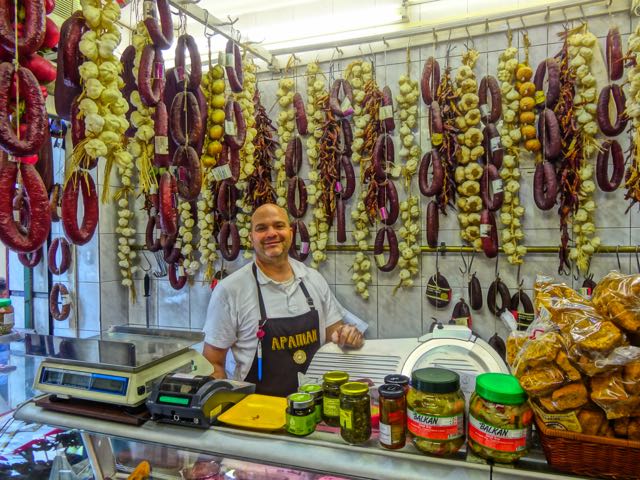 Loukaniko are sausages and there are as many types as at that place are people to brand them. Among the most popular are those from Naxos. Spetsofai is a dish from Volos that is made with sausage, peppers, tomatoes and onions and is eaten in the wintertime and usually with tsipuro or ouzo. Sousoukia are in the sausage family and are heavily spiced and often salty. Pastourma has an appearance of pastrami but is cured beefiness with a paste of spices around it. We used to call it camel meat and perhaps historically that is what it was. This is sliced and eaten cold as an appetiser or baked with cheese and love apple sauce to make saganaki pastrama. Information technology can also exist found in pastramatopita, which is a pie, made with pastrama and cheese. On the island of Kea one of the specialities is smoked pork loin. On Evripidou Street near the Athens Central marketplace there are shops that specialize in loukaniko and smoked meats, notably Arapian which is Armenian and is the nigh famous. I get here for pastourma and their spicy soutsouk from Turkey. Loukaniko are sausages and there are as many types as at that place are people to brand them. Among the most popular are those from Naxos. Spetsofai is a dish from Volos that is made with sausage, peppers, tomatoes and onions and is eaten in the wintertime and usually with tsipuro or ouzo. Sousoukia are in the sausage family and are heavily spiced and often salty. Pastourma has an appearance of pastrami but is cured beefiness with a paste of spices around it. We used to call it camel meat and perhaps historically that is what it was. This is sliced and eaten cold as an appetiser or baked with cheese and love apple sauce to make saganaki pastrama. Information technology can also exist found in pastramatopita, which is a pie, made with pastrama and cheese. On the island of Kea one of the specialities is smoked pork loin. On Evripidou Street near the Athens Central marketplace there are shops that specialize in loukaniko and smoked meats, notably Arapian which is Armenian and is the nigh famous. I get here for pastourma and their spicy soutsouk from Turkey. | | 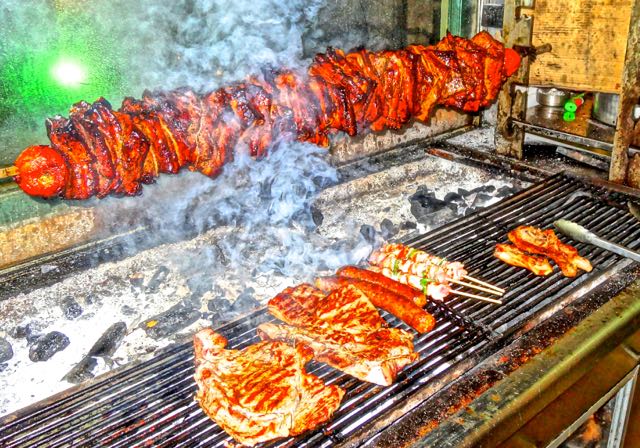 Brizoles are steaks, unremarkably pork, veal or beef and mostly served well-done with fried potatoes. There are some restaurants in Athens, like Telis nigh Platia Komoundourou that specialize in hirino brizoles (grilled pork-chops). In fact all they serve is hirino brizoles, fried potatoes, salad, and sadziki. In that location are restaurants that actually serve lambs head. They split up information technology open for you then you don't have to bring a hammer and chisel with you lot, but information technology is not the best thing on the carte du jour and may not be that healthy for you lot either. The lamb's brain is considered a delicacy but information technology has the consistency of oatmeal and tastes what you would expect a encephalon to gustation like. You tin can go brizoles in just about any taverna or psistaria as well as whatsoever of the tourist restaurants in the Plaka. Past the way the Greeks don't practise medium-rare. Grilled meats are pretty much ever well-done unless you go to an American-way steak firm. Brizoles are steaks, unremarkably pork, veal or beef and mostly served well-done with fried potatoes. There are some restaurants in Athens, like Telis nigh Platia Komoundourou that specialize in hirino brizoles (grilled pork-chops). In fact all they serve is hirino brizoles, fried potatoes, salad, and sadziki. In that location are restaurants that actually serve lambs head. They split up information technology open for you then you don't have to bring a hammer and chisel with you lot, but information technology is not the best thing on the carte du jour and may not be that healthy for you lot either. The lamb's brain is considered a delicacy but information technology has the consistency of oatmeal and tastes what you would expect a encephalon to gustation like. You tin can go brizoles in just about any taverna or psistaria as well as whatsoever of the tourist restaurants in the Plaka. Past the way the Greeks don't practise medium-rare. Grilled meats are pretty much ever well-done unless you go to an American-way steak firm. | | 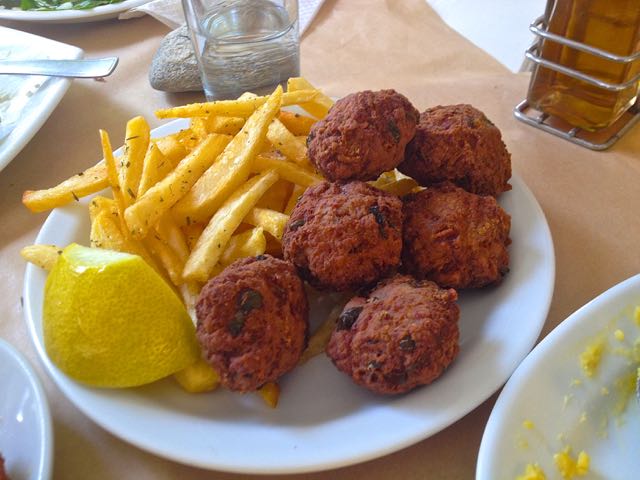 Kima , which means meat and usually means beef, is establish in the about basic pasta dish of all called macaronia me kima a meal that has provided sustenance for many a tourist kid who was not adventurous enough to try other Greek dishes. It is a plate of macaroni with a pile of ground beef that has been cooked in a pot with onions, garlic, oregano, salt and pepper. It'due south good and proves that pasta with meat sauce can survive the absence of tomatoes. A better utilise of ground beef is soutzoukakia which are oblong patties fabricated of ground beef (or pork or veal if yous like), lots of cumin, onion, oregano and grilled. These can be served plain or further cooked in a tomato plant sauce, which is more common in Greek restaurants. And of course beefteakia, the bun-less hamburger, with fried potatoes is another child pleaser for difficult immature eaters. Beefteakia are like hamburgers, though seasoned so expertly you won't even miss the ketchup. Keftedes (photo) are meatballs, usually a smaller version of beefteakia though they are more often deep-fried than they are grilled. Many people put lemon on their beefteakia, keftedes and brizoles. I practise anyway. Kima , which means meat and usually means beef, is establish in the about basic pasta dish of all called macaronia me kima a meal that has provided sustenance for many a tourist kid who was not adventurous enough to try other Greek dishes. It is a plate of macaroni with a pile of ground beef that has been cooked in a pot with onions, garlic, oregano, salt and pepper. It'due south good and proves that pasta with meat sauce can survive the absence of tomatoes. A better utilise of ground beef is soutzoukakia which are oblong patties fabricated of ground beef (or pork or veal if yous like), lots of cumin, onion, oregano and grilled. These can be served plain or further cooked in a tomato plant sauce, which is more common in Greek restaurants. And of course beefteakia, the bun-less hamburger, with fried potatoes is another child pleaser for difficult immature eaters. Beefteakia are like hamburgers, though seasoned so expertly you won't even miss the ketchup. Keftedes (photo) are meatballs, usually a smaller version of beefteakia though they are more often deep-fried than they are grilled. Many people put lemon on their beefteakia, keftedes and brizoles. I practise anyway. | | 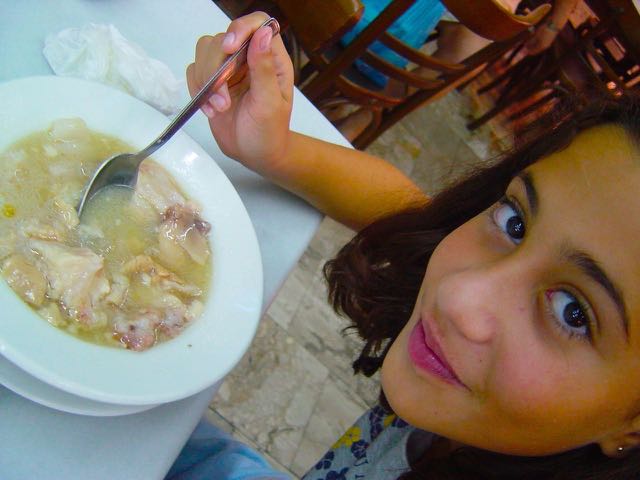 Yida is a stew fabricated of beefiness and vegetables that tastes slap-up in the winter and is probably pretty healthy, at to the lowest degree equally good for you equally craven soup. Patsa (photo), which I have gone into some item about on another folio, is tripe, the innards of a lamb, boiled in a soup and supposedly good for you too. Some people beloved it and some think information technology tastes similar shit, which information technology sometimes does, non surprisingly since the intestines are a primary ingredient. In the aforementioned family is mayeritsa, the traditional soup used for breaking the 40 day fast, with similar ingredients to patsa, though this is definitely lamb, the same lamb yous volition be eating the next day on Easter Sunday. It is light-green in color with chunks of livers and other organs floating around. Information technology tastes better than it looks which is non likewise difficult. Podi, which means human foot, is a soup fabricated from, yous guessed it: a foot. Commonly the foot of a cow. The active ingredient, I am guessing, is the marrow which gives it a sticky kind of texture. Only I can speak from experience and tell you lot that equally icky as it looks (it is later all a basin of broth with a pes in it), podi really is a sort of cure-all for hangovers and even flu-similar symptoms. The best identify for podi, patsa and mayeritsa is the working grade Iepirus Restaurant in Athen central market but many islands take one working-class restaurant that specializes in patsa and podi. Yida is a stew fabricated of beefiness and vegetables that tastes slap-up in the winter and is probably pretty healthy, at to the lowest degree equally good for you equally craven soup. Patsa (photo), which I have gone into some item about on another folio, is tripe, the innards of a lamb, boiled in a soup and supposedly good for you too. Some people beloved it and some think information technology tastes similar shit, which information technology sometimes does, non surprisingly since the intestines are a primary ingredient. In the aforementioned family is mayeritsa, the traditional soup used for breaking the 40 day fast, with similar ingredients to patsa, though this is definitely lamb, the same lamb yous volition be eating the next day on Easter Sunday. It is light-green in color with chunks of livers and other organs floating around. Information technology tastes better than it looks which is non likewise difficult. Podi, which means human foot, is a soup fabricated from, yous guessed it: a foot. Commonly the foot of a cow. The active ingredient, I am guessing, is the marrow which gives it a sticky kind of texture. Only I can speak from experience and tell you lot that equally icky as it looks (it is later all a basin of broth with a pes in it), podi really is a sort of cure-all for hangovers and even flu-similar symptoms. The best identify for podi, patsa and mayeritsa is the working grade Iepirus Restaurant in Athen central market but many islands take one working-class restaurant that specializes in patsa and podi. | | 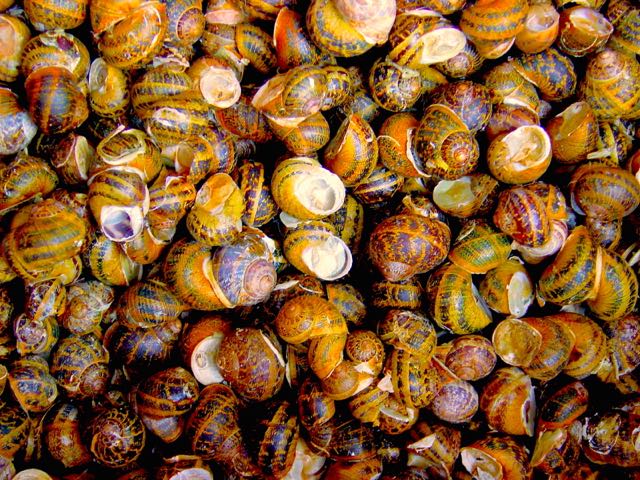 Souvlakia are the virtually popular meat dish in Hellenic republic and deserve a page all their own and indeed they do take one on my Souvlaki folio so there is no need to go into particular here. Rabbit is less mutual simply is an ingredient in a popular dish called Stifado. This is a stew of rabbit, small-scale onions and a heavy sweet tomato plant sauce with a potent season of cloves. Y'all can also brand stifado with chicken or beef. When you purchase rabbit in the butcher store they volition oft leave the fur on the feet so you will know that information technology is rabbit and non a cat. Psaronefi is pork tenderloin, roasted or cooked on a spit. Roloi is a blimp pork loin. Sikotaria is 1 of my favorite dishes, usually made from the liver, heart and other organs of lamb and cooked in a wine sauce. The all-time I have ever had is at O Bakalogatos restaurant in Kypseli. I don't know if you could classify them every bit a meat merely they are not a fish or vegetable and then let me just mention that saligari are snails, usually cooked in a wine and tomato plant sauce. They sell them in the market. My mother bought some and they told her to put them in a pot with water. They did not say to cover the pot. We were finding snails all over the business firm for years. Souvlakia are the virtually popular meat dish in Hellenic republic and deserve a page all their own and indeed they do take one on my Souvlaki folio so there is no need to go into particular here. Rabbit is less mutual simply is an ingredient in a popular dish called Stifado. This is a stew of rabbit, small-scale onions and a heavy sweet tomato plant sauce with a potent season of cloves. Y'all can also brand stifado with chicken or beef. When you purchase rabbit in the butcher store they volition oft leave the fur on the feet so you will know that information technology is rabbit and non a cat. Psaronefi is pork tenderloin, roasted or cooked on a spit. Roloi is a blimp pork loin. Sikotaria is 1 of my favorite dishes, usually made from the liver, heart and other organs of lamb and cooked in a wine sauce. The all-time I have ever had is at O Bakalogatos restaurant in Kypseli. I don't know if you could classify them every bit a meat merely they are not a fish or vegetable and then let me just mention that saligari are snails, usually cooked in a wine and tomato plant sauce. They sell them in the market. My mother bought some and they told her to put them in a pot with water. They did not say to cover the pot. We were finding snails all over the business firm for years. Needless to say, Greece is a meat eater's paradise. But those who love fish and vegetables should not be put off by this page because for yous there are just as many choices. If not more. | | 
0 Response to "How Much Beef Is Consumed in Greece Each Year"
Postar um comentário